
Calculation of hull geometries in spherical space
Usage
shull(x, s, ...)

# S4 method for class 'matrix,missing'
shull(
  x,
  method,
  long = NULL,
  lat = NULL,
  duplicates = FALSE,
  plot = FALSE,
  plot.args = NULL,
  sphererad = authRadius
)

# S4 method for class 'data.frame,missing'
shull(x, long = "long", lat = "lat", ...)

# S4 method for class 'matrix,trigrid'
shull(
  x,
  s,
  method,
  long = NULL,
  lat = NULL,
  duplicates = FALSE,
  plot = FALSE,
  plot.args = NULL,
  sphererad = authRadius,
  drop = TRUE
)

shullarea(x, ...)

# Default S3 method
shullarea(
  x,
  method,
  metric = "area",
  full = FALSE,
  sphererad = authRadius,
  ...
)

# S3 method for class 'shull'
shullarea(x, metric = "area", s = NULL, full = FALSE, ...)
Arguments
- x
Either a 2-column numeric matrix with two columns: longitudes and latitudes, or a
data.framewith these columns.- s
An external spatial structure to resolve the hull (e.g. a
hexagridobject.)- ...
Additional arguments passed to class-specific methods.
- method
characterHull construction method. Currently available:"centroidcircle"- long
character, column name of the longitudes.- lat
character, column name of the latitudes.- duplicates
logical, should identical coordinates be included in the calculation (default isFALSE).- plot
Logical, should the result be plotted? Will plot over active plot (as in
add=TRUE), if there is any.- plot.args
List arguments passed to the plotting function:
lines.- sphererad
numericThe radius of the sphere used in the calculations, defaults to the authalic radius of Earth in km (6370.997).- drop
logicalIn casesis provided, should the returned object be a hull-class object, or only the identifiers ofs(drop=FALSE)?- metric
characterWhat metric should be used for area of the hull?areareturns the values in square of the unit ofsphererad(defaults to square km),propreturns the area as a proportion of the sphere,countreturns the area as the number of components it occupies ins, when applicable.- full
Logical switch indicating whether only the estimate should be shown (
FALSE), or the hull itself should be returned as well?.
Value
A hull-class object, a vector of identifiers (if applicable and drop=FALSE) or the area of te hull as a numeric.
Details
Constructing and enclosing geometry around a distribution on the surface of a sphere represent unique challenges.
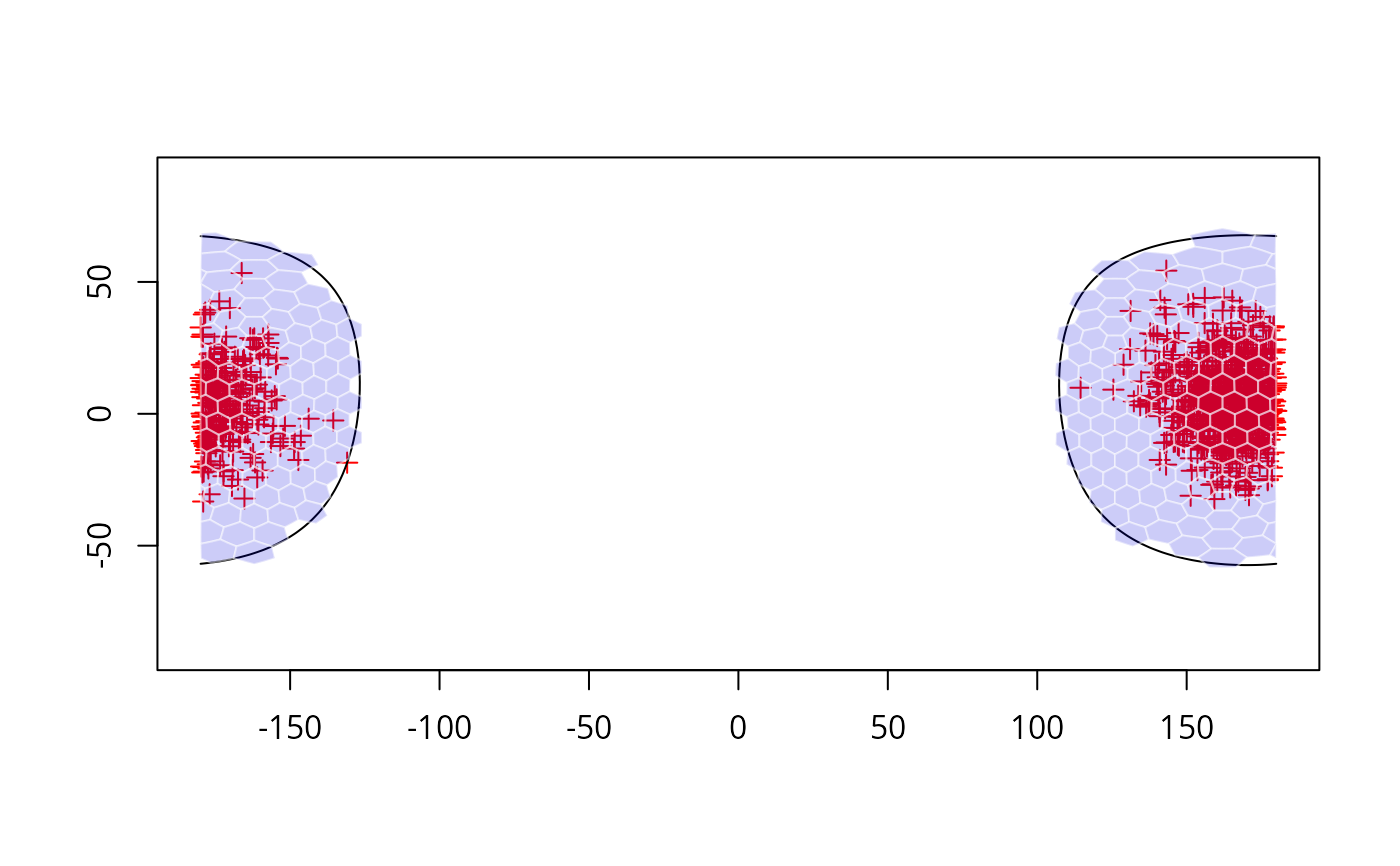
The "centroidcircle" method is using the centroid of the distribution as the center of small circle that defines a spherical cap. This is likely not the smallest possible cap to cover the distribution and takes the heterogeneous density of the distribution into account.
Examples
# example data
data(kentsamples)
p <- kentsamples$dateline_m
# plotting
plot(NULL, NULL, xlim=c(-180, 180), ylim=c(-90,90), xlab="", ylab="")
points(p, pch=3, col="red")
# basic spherical hull definition (native)
cc <- shull(p, method="centroidcircle")
plot(cc, add=TRUE)
# spherical hull area calculation
shullarea(cc)
#> [1] 137466948
# basic hull definition (icosahedral grid)
hex <- icosa::hexagrid(spacing=8, sf=TRUE)
#> Selecting hexagrid with tessellation vector: c(3, 3).
#> Spacing: 7.686 degrees.
# dropping hull container
cc_hex <- shull(p, s=hex, method="centroidcircle")
#> Unfinished implementation! - Proper lookup of small circles required!
plot(hex, cc_hex, col="#0000DD33", border="#FFFFFF77", add=TRUE)
 # with shull container
cc_hex2 <- shull(p, s=hex, method="centroidcircle", drop=FALSE)
#> Unfinished implementation! - Proper lookup of small circles required!
shullarea(cc_hex2, s=hex, metric="prop")
#> [1] 0.2684729
# with shull container
cc_hex2 <- shull(p, s=hex, method="centroidcircle", drop=FALSE)
#> Unfinished implementation! - Proper lookup of small circles required!
shullarea(cc_hex2, s=hex, metric="prop")
#> [1] 0.2684729